Live alerts
Know when the clear window opens, the Moon sets, or an ISS pass begins.
Stella turns clarity, moonlight, and darkness into one plan: when to go, where to go, and what to see.
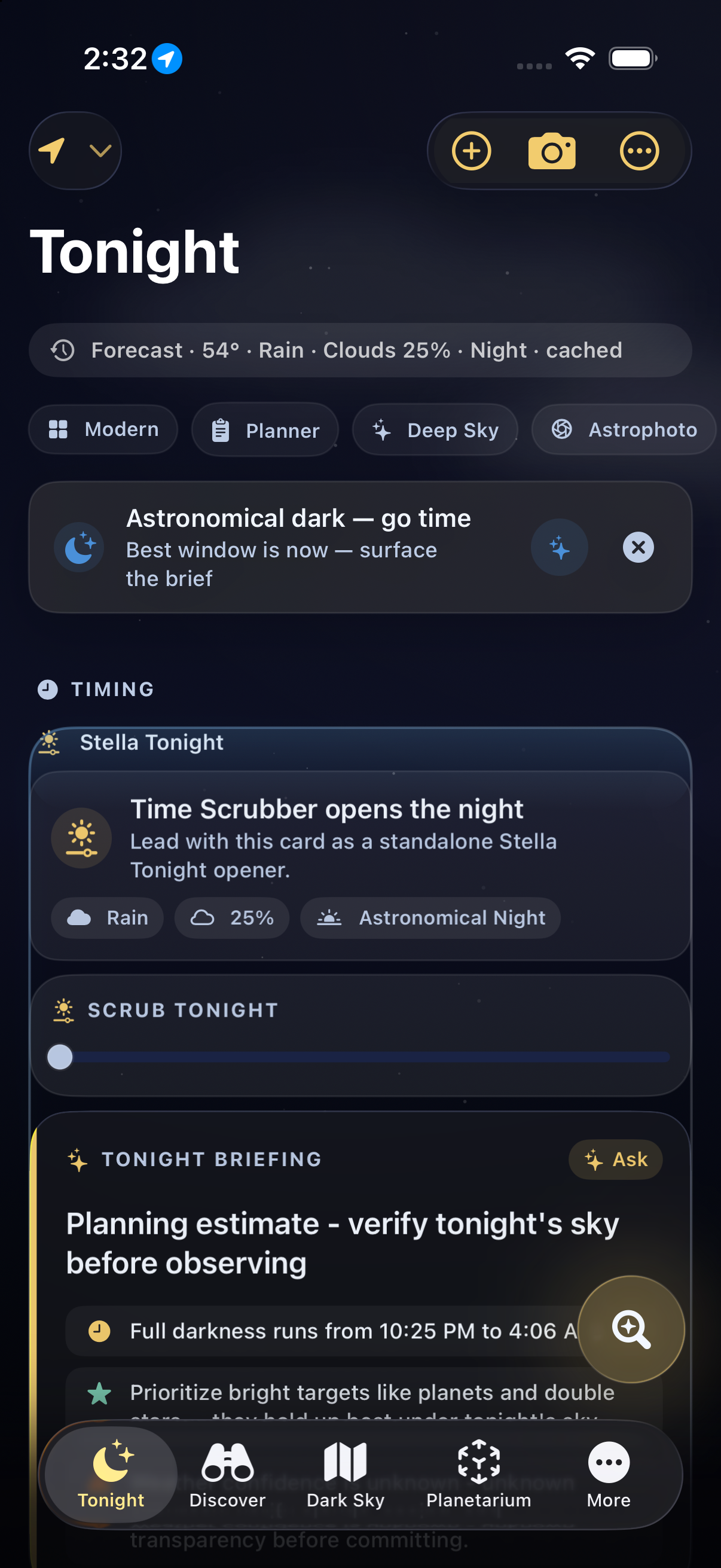
Search a city or dark-sky place. Stella combines live clouds, transparency, smoke, wind, moonlight, astronomical darkness, and nearby dark-sky quality into one decision.
Moonlight and darkness are computed for this location. The live score adds cloud, humidity, visibility, smoke, haze, and wind.
Loading live sky conditions…
Stella turns a pile of forecasts into one decision — then takes you from the verdict to the dark site to the stars themselves.
Open Stella and one number tells you if the sky is worth it — clouds, transparency, seeing, moonlight, and darkness, weighed together.
The Bortle dark-sky map shows the darkness near you and routes you to the closest genuinely dark spot — parks, reserves, and observing sites.
Raise your phone and the AR sky map names the stars, planets, and satellites overhead — then drops into a full planetarium to explore.
Stella models the real sky overhead: the stars, planets, satellites, meteor showers, and dark-sky places above you right now — then tells you what’s actually worth going outside for. Tap a landmark to explore it in 3D.
Know when the clear window opens, the Moon sets, or an ISS pass begins.
Raise your phone to name stars, planets, constellations, and satellites.
Compare Bortle class, distance, and nearby observing places before leaving.
Stella is developing event support for community star parties, schools, festivals, private gatherings, hospitality programs, and brand events. Register your interest while we shape the equipment, facilitation, media, and app experience.
Stella plans to bring telescopes, shape a target list for the date and location, and help first-time observers enjoy the view without needing their own gear.
The planned service can add a safe daytime astronomy program with purpose-built solar telescopes, guided viewing, and approachable science for your audience.
Planned coverage can document the people, telescopes, and sky for event recaps, social clips, interviews, and partner storytelling.
The planned app experience gives registered attendees one event hub plus temporary Ultra access during an agreed event window.
Free handles tonight. Pro and Ultra unlock deeper planning and imaging tools.
Free forever
Everything to decide on tonight.
Just $3.99/mo, billed annually
For the regular stargazer.
Just $8.99/mo, billed annually
For astrophotographers & rigs.
Yes. The Tonight score, best observing window, a 3-day conditions forecast, AR identify, the planetarium, and your saved sites are all free, forever. Pro and Ultra unlock deeper forecasts, the dark-sky map, alerts, and imaging tools.
Pro is for the regular stargazer — 10-day and hourly astronomy forecasts, the dark-sky map with the Bortle layer and routing, Live Activities, alerts, widgets, Destinations, and trip boards. Ultra adds the serious imaging stack: telescope and mount control, plate-solving, an imaging planner, and advanced capture tools.
Subscribing on the web skips the app-store fee, so we pass the savings on — up to 43% off. Your membership unlocks automatically in the app the next time you open it; nothing extra to set up.
Stella blends astronomy-grade cloud, transparency, and seeing forecasts with precisely computed moonlight and the astronomical-darkness window for your exact location. Like any forecast it isn't a guarantee, but it's tuned to answer one question well: is tonight worth the drive?
Yes. Trip boards bundle your targets, timing, gear, and the night's plan so the essentials work when there's no signal. The AR sky map and planetarium also run from on-device ephemeris.
On the Ultra tier, yes — Stella includes mount and telescope workflows, plate-solving to confirm where you're pointed, an imaging planner, and advanced camera and capture tools.
iPhone and iPad, with companion experiences on Apple Watch, Mac, and CarPlay — so the plan follows you from the couch to the car to the field.
From trusted public sources — NASA, NOAA's Space Weather Prediction Center for aurora, Celestrak and The Space Devs for satellites and launches, plus astronomy-grade weather and dark-sky datasets — all combined into one plan.
Stella tells you which—and exactly where to go when it is.